 Contact
Experimental Project
The Productivty Paradox
Unpacking the lie of the Productivity Industry through an Interactive Art Installation
Social Media - Productivity
Experimental Solo Project
Interactive Art Installation
4 Months
Overview
As a human-centred designer, I question the systems that promise growth or “success.” In today’s world, productivity is branded, gamified, and sold—often at the cost of wellbeing and meaning.
I’ve felt this trap myself, stuck in cycles of planning and consuming tools instead of making real progress. This project challenges that illusion, showing how the productivity industry fuels burnout, comparison, and anxiety.
Through human-centred design, I explore the deeper emotional and cultural layers of our relationship with technology. In a hustle-driven era, productivity has become a marketable ideal, yet the paradox remains: are we achieving more, or just consuming advice about achieving?
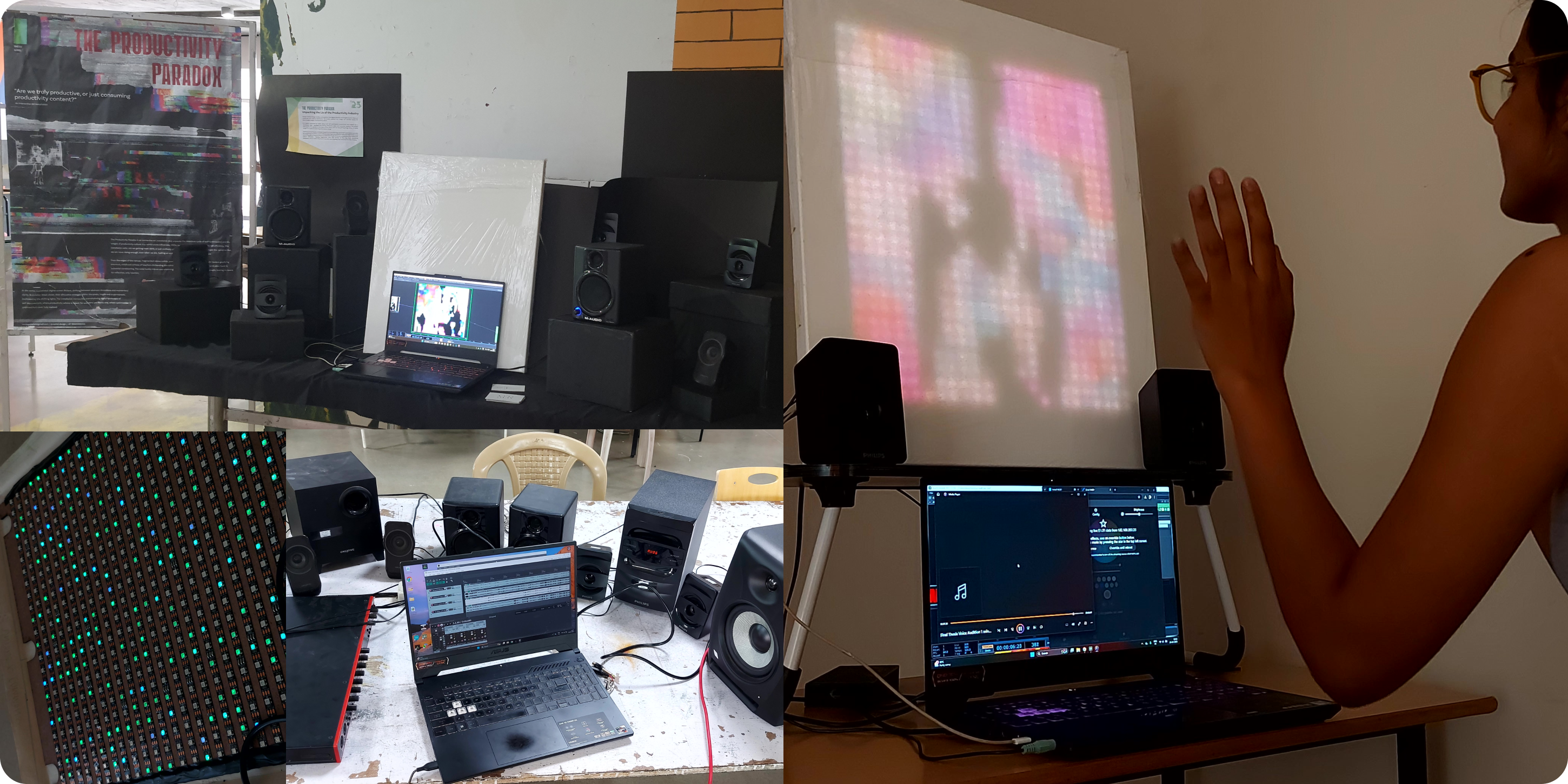
The Productivity Paradox, an interactive art installation, immerses visitors in this cycle. Fragmented voices and flickering lights surround them, only for their silhouette to vanish as they step back—echoing the Myth of Sisyphus. In the end, nothing is accomplished, only the illusion of doing.
THE PRODUCTIVITY PARADOX
“If the product is free, we are the product. No, we are the workers for the product”
You are not productive enough. Influencers sell a dream of effortless success while monetizing
procrastination.
Influencers, apps and books promise efficiency but often trap users in cycles of overwork, digital
dependency, and consumerism.
In India, hustle culture, ed-tech, and startup environments such as in Bangalore and Gurugram amplify
the illusion of productivity. By deconstructing the deceptive marketing strategies of productivity apps and
influencers, the project aims to reveal the hidden trade-offs behind the promise of self-optimization.
This topic is not just timely but deeply personal, reflecting shared experiences of navigating tools like
Notion, Forest, and Productivity influencers like Ankur Warikoo, Tam Kaur, and Jun Yuh.
It investigates the broader societal and psychological consequences of this phenomenon, especially for
young professionals, students, and freelancers balancing aspirations with well-being.
POSITIONALITY AS A HUMAN-CENTERED DESIGNER
As a human-centered designer, I am deeply interested
in uncovering the subtle ways in which technology,
content, and ourselves shape our everyday behaviors and
perceptions.
This project stems from a personal entanglement with the
world of productivity content where motivation is marketed,
and doing is replaced by the constant pressure to be
optimizing.
What began as a search for discipline and structure slowly
morphed into a ritual of watching, planning, and self-monitoring, leaving behind a trail of unfinished to-do lists.
As someone who has consumed hours of such content while
procrastinating the very tasks it was meant to help with, I
began questioning the systems that frame productivity as a
performance rather than a process.
It made me reflect on how easily we conflate the aesthetics
of productivity with actual progress screens full of trackers,
dashboards, and timers giving us the illusion of control.
My design approach attempts to reflect the psychological
toll of this paradox, unmasking the emotional, cognitive,
and cultural impact of a self-optimization industry that often
profits off our insecurities.
Through critical inquiry and an immersive artifact, I aim
to center the human experience behind the hustle where
intention is often lost in the noise of endless doing
Read about the project!
No part of this book may be reproduced, stored, or transmitted in any form —digital or physical— without the prior written permission of the author, Mehal Kumar.